The monster fits into a handful of pixels. The imagination does the rest, until a filmed scene gives it a face, a texture, a distorted human presence. It is in that passage between two ways of seeing horror that Tenebris Somnia finds its most interesting argument. The Argentine game arrived on October 16, 2026, posing a tantalizing question for anyone who follows the genre: how much of our fear comes from what we see, and how much emerges when the way it is shown changes?
Developed by Andrés Borghi and Saibot Studios and published by New Blood Interactive, the title combines 2D survival horror, pixel art and live-action sequences. The official Steam page cites Resident Evil and Silent Hill as influences, alongside an aesthetic associated with 8-bit and 16-bit games. The concept includes combat and puzzles. It is a meeting of visual languages that deserves attention for what it might do with our expectations, well beyond the novelty of seeing a video game become a film.
When the image changes, fear changes with it
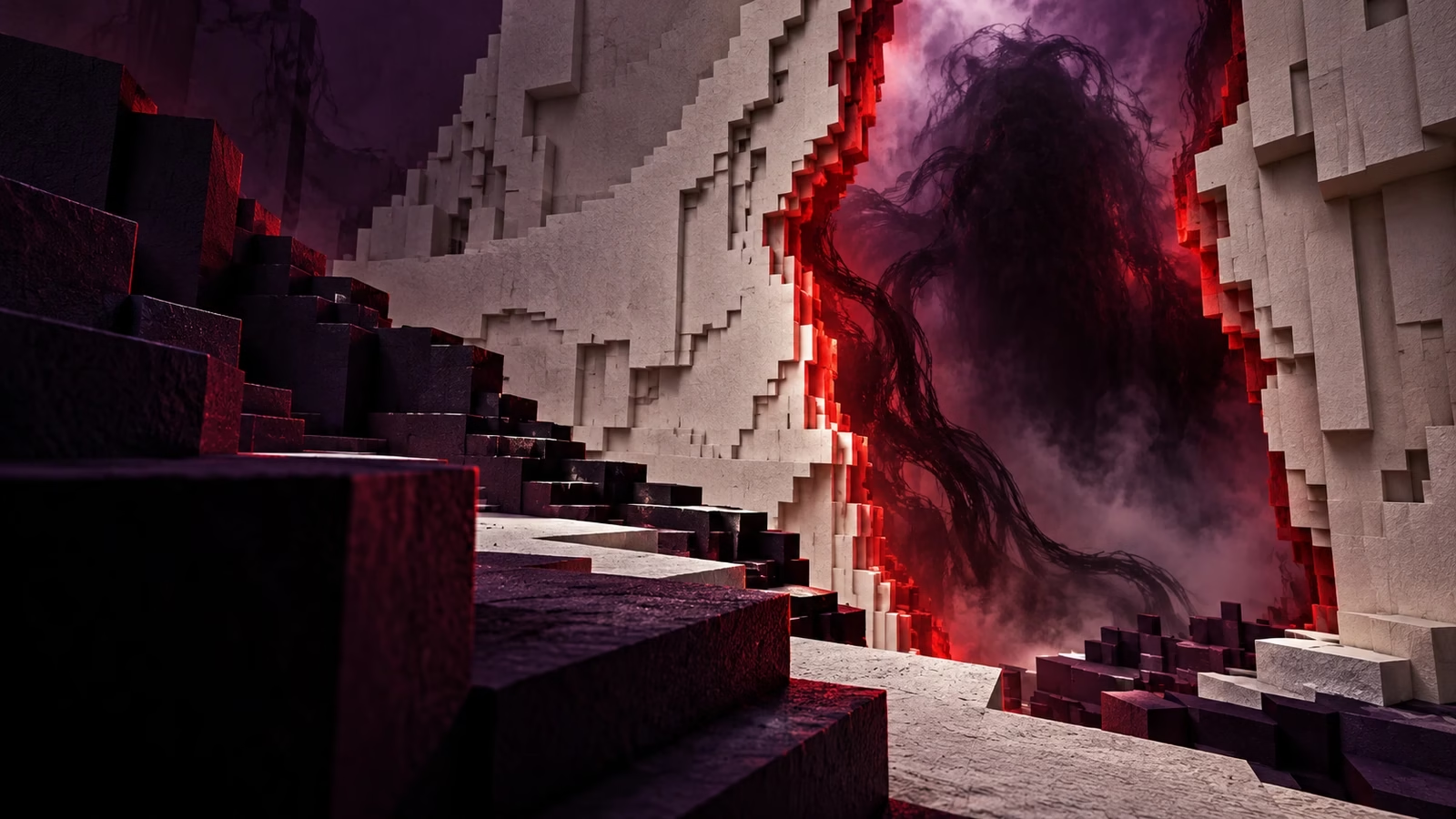
A pixel-art environment asks the viewer to take part. A dark patch can suggest depth; a silhouette is enough to signal that something is wrong. There is pleasure in interpreting those shapes, even when they are unpleasant. Players learn to read that world and, over time, establish a kind of agreement with the screen: they recognize its distances, its proportions and its visual limits.
The arrival of a filmed image has the potential to disrupt that agreement. Skin, light and movement belong to our everyday visual vocabulary. We can recognize a body before we even think about it. A distortion can therefore take on a different weight when it appears in something that seems tangible, lit within a space someone could visit. The contrast allows the same threat to be imagined in one way and presented in another.
That is the reading invited by the combination Tenebris Somnia has announced. The change in visual language can function as a directing tool: the moment chosen for a reveal matters as much as the creature revealed. There is also an obvious creative risk. If the switch becomes predictable, the scares start running on a schedule. Sustaining uncertainty takes rhythm, continuity and care so that two aesthetics seem to belong to the same nightmare.
The official images and behind-the-scenes material published on Xbox Wire offer a closer look at this visual concept.
Argentine cinema enters the frame
In the account published on Xbox Wire, Airdorf, executive producer and creator of FAITH, introduces Julia: nightmares about her ex-boyfriend lead her to his apartment. He says Borghi conceived the mixture while streaming FAITH and developed a demo with Saibot’s Tobías Rusjan.
According to Airdorf, Clara Kovacic plays the protagonist, while Marcos Berta, of When Evil Lurks, supervised practical effects. Borghi directed the scenes. The producer describes almost four years of production, silicone prosthetics and makeup that took hours of preparation. He also says the sequences connect to the gameplay and can occur alongside confrontations.
Those production details add an important dimension to the project: filming monsters is also precision work. A creature needs to occupy the space, respond to the lighting and remain consistent between shots. A detail that looks grotesque for a few seconds on screen can require lengthy preparation off it. Thinking about that adds another layer of interest for audiences who enjoy horror films as much as games.
The presence of an Argentine team also deserves to be in the foreground. Discussing Latin American production becomes more interesting when the names and creative choices receive attention. Here, there is a concrete collaboration between game development and cinema. The proposed result has enough identity to be discussed in terms of how it is built, without reducing the project’s origins to a footnote.
A budget alone does not explain a nightmare
Comparing this concept with the race for big-budget graphics requires care: the sources consulted do not provide a budget that would allow financial differences to be established. The point is artistic. Tenebris Somnia uses a combination that organizes the audience’s attention around the change in imagery. That sort of decision can be more memorable than simply increasing the amount of detail on a surface.
Art direction involves choosing what deserves emphasis and what should remain hidden. In horror, concealment is an especially valuable tool. A figure that is only partly comprehensible leaves room for anticipation. Showing too much can end that process; showing something at the right moment can make it worse. The mixture of pixel art and filmed footage offers two different distances from which to work on that reveal.
There is also a fruitful conversation between the handcrafted and the strange. Imperfection can cause unease, but it needs to be part of a visual intention. Audiences notice when a work establishes its own rules and then puts them under strain. That is one reason a strong formal idea sparks curiosity even before any discussion of resolution or lighting technology.
In the behind-the-scenes article, Airdorf says no generative AI was used in production and describes hand-drawn art, practical effects and limited CGI. This is a statement from the producer. For this reading, what matters most is how that choice relates to the concept: drawing, filming and editing are different ways of deciding exactly what the audience will face.
For survival horror, the decisive question remains the relationship between vulnerability and action. A monster can be visually fascinating, but it also needs to find its place in the rhythm of exploring, hesitating and moving forward. The curiosity surrounding Tenebris Somnia comes from that meeting: how do you sustain the tension between a filmed reveal and the next decision in the player’s hands? That question makes the concept worth discussing beyond an eye-catching trailer, and a hands-on assessment will be able to answer it.
Watch the official trailer
The launch trailer released by Xbox offers a look at the combination of styles. Please note: the video contains horror imagery.
Watch the official trailer on YouTube.
Where to find Tenebris Somnia
The New Blood page lists PC, PlayStation 5, Xbox Series and Nintendo Switch 2. Steam offers a demo and Brazilian Portuguese interface and subtitle support. The Xbox store confirms Xbox Series X|S, PC and Xbox Play Anywhere.
This article analyzes the concept and official promotional material, without a hands-on assessment of the full game. It is an invitation to follow a project that places visual direction at the center of the conversation about fear. Tenebris Somnia has an idea that is easy to explain and full of possibilities: making the image change just when we thought we had learned how to look at it.